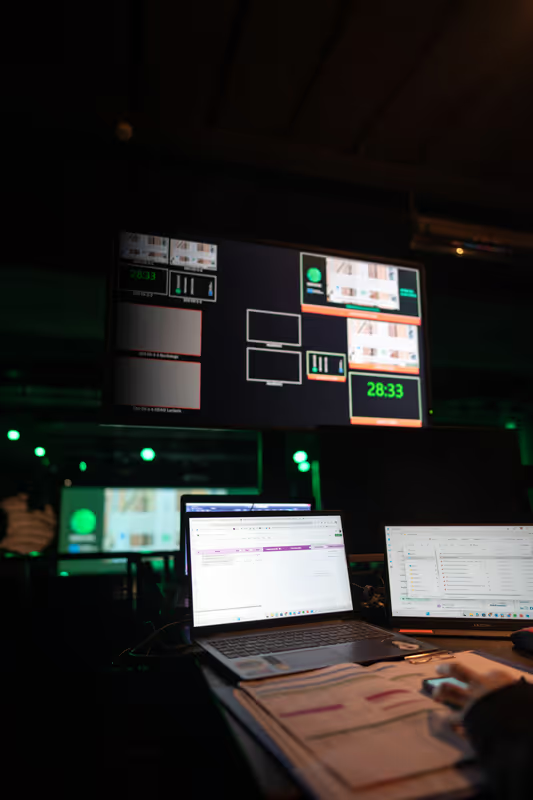
Logistics are strategic whether people realise it or not
When people talk about successful events, they rarely mention logistics. Instead, the quality of the speakers, the relevance of the discussions, the atmosphere in the room, or the visibility generated afterwards tend to be the focus while logistics remains invisible.
Yet every event professional knows there’s much that doesn’t meet the eye.
The work nobody notices until it goes wrong
A delayed approval can postpone production. A superficial supplier briefing can affect the participant experience. A poorly coordinated registration process can create frustration before the programme even begins. Long before attendees enter the room, logistics are already influencing whether an event can achieve its objectives.
This is why logistics should not be treated as a purely operational concern. When logistics work well, everything else can shine. When they don’t work, everything else disappears.
Complexity grows faster than most organisations expect
Many organisations organise events only occasionally. Others manage dozens every year. In both cases, without proper oversight, logistical complexity tends to increase gradually until it becomes difficult to control.
It’s a well-known story: multiple departments need to align, procurement procedures need to be respected, suppliers require clear instructions, approvals move through several layers of management… until small changes in one area create consequences elsewhere, causing deadlines to overlap and teams to come close to burn out.
Although your team works extremely hard to make events happen, the challenge is maintaining consistency and coordination when many moving parts depend on each other. Without clear systems, organisations may find themselves solving the same problems repeatedly. Timelines become reactive instead of proactive. Knowledge remains with individuals rather than processes. Last-minute pressure becomes normal.
Over time, that pressure affects both efficiency and results.
Professionals carry a different kind of pressure
For event professionals, the challenge is making sure everything happens at the right moment.
Managing suppliers. Tracking deliverables. Confirming registrations. Monitoring budgets. Coordinating speakers. Solving unexpected issues. Preparing contingency plans. Doing all of this well requires strong coordination, negotiation, problem-solving, and decision-making skills.
Logistics shape the experience
What makes logistics difficult is that success is measured by the absence of problems. Participants rarely see the contingency plan that prevented a disruption. Stakeholders rarely notice the dozens of small adjustments that kept a project on track.
But these invisible decisions are often what determine whether an event feels smooth and professional.
Participants may never see the project timeline.
They will notice whether registration is efficient. Whether signage is clear. Whether speakers receive the right support. Whether sessions start on time. Whether information is easy to access. Whether transitions feel natural. These details are often categorised as logistics, yet they directly influence how people experience an event.
The participant experience is not created only through content or communication. It is also created through coordination, and this is why logistics are just as important as strategy.
How haca.studio helps organisations
Sometimes the issue is not the event itself. The issue is the process behind it.
Through our audit services, we help organisations identify bottlenecks, inefficiencies, and recurring logistical challenges. We review workflows, responsibilities, approval structures, supplier management processes, and operational practices to understand where friction occurs and how it can be reduced.
Through advisory services, we help organisations build stronger systems before problems emerge. This can include designing event workflows, improving coordination between teams, establishing planning frameworks, defining responsibilities, or creating practical procedures that support consistent delivery across multiple events.
The objective is not simply to organise a single successful event. It is to create a stronger operational foundation for future projects.
How haca.studio helps professionals
Many event professionals already know what good logistics look like. What they need is support in managing complexity with confidence.
Through coaching, we work with professionals who want to strengthen their planning methods, improve stakeholder management, structure their workflows more effectively, and develop practical approaches to risk management and contingency planning.
The goal is to help professionals build the judgement, systems, and habits that allow them to navigate increasingly complex projects while maintaining control and reducing unnecessary pressure.
The strongest events are built long before they begin
Logistics are often viewed as the final stage of planning. In reality, they influence every stage that comes before.
A strategy can be ambitious. Tactical choices can be well designed. But if coordination breaks down, approvals stall, suppliers receive conflicting information, or operational details are overlooked, the event will struggle to deliver its intended impact.
This is why logistics are strategic whether people realise it or not.
Because every participant's experience, every stakeholder interaction, and every event objective ultimately depends on the ability to turn plans into reality.
Conclusion
Read more
Discover more of our journals, a treasure trove of valuable insights, practical tips, and industry trends that will take your events to the next level.

.jpg)
.jpg)









.avif)