How to choose the right event venue
There is a moment, early in the event organisation process, when the venue becomes the focus. It often happens too soon.
A shortlist is drafted, availability is checked, capacities are compared. The conversation quickly turns practical. But if the most relevant questions are still unanswered, things can go badly wrong.
The right venue is not a starting point. It is the consequence of a series of decisions that come before it.
If those decisions are clear, the venue almost selects itself.
Start with the goal, not the room
Every event is trying to do something specific. Clarity about the purpose of an event is the first step in the process of choosing a space.
Is the intention to inform, to align, to challenge, to build trust, to create momentum? These are not interchangeable. They shape everything that follows.
An event designed to support thought leadership requires a different environment than one focused on internal alignment. A high-level policy exchange does not thrive under the same conditions as a community-driven workshop.
This is where many venue choices go wrong. The space is selected for its features, not for its ability to support a precise outcome.
If the goal is clarity, the venue needs to remove friction. If the goal is exchange, it needs to encourage proximity and conversation. If the goal is visibility, it must support how messages travel beyond the room.
This is also where your earlier thinking on positioning and authority can come in. A space can reinforce credibility, or dilute it.
The audience changes everything
Once the objective is clear, the next layer is the people in the room.
Who they are, how they relate to each other, and what they need to feel comfortable engaging will influence the venue more than any technical specification.
A group of institutional stakeholders accustomed to formal settings will navigate space differently than a mixed audience of practitioners and newcomers. Seniority, cultural context, and familiarity with the topic all shape how people occupy a room.
This is not just about comfort. It is about behaviour. And this is where location becomes part of the audience equation.
If participants are travelling, proximity to transport hubs matters, but so does the first impression the city creates. A central, well-connected area reduces friction, while a more distinctive neighbourhood can create a stronger sense of occasion.
Even within the same city, the micro-location shapes behaviour. A venue surrounded by offices encourages a more structured rhythm. One embedded in a cultural or residential area can make the event feel more open, less transactional.
These choices connect directly to your work on stakeholder mapping and visibility. The venue and its location influence who shows up, how they show up, and how easy it is for them to stay engaged throughout the day.
It also affects practical flows. Arrival, informal moments between sessions, where people go for a break, whether they stay nearby after the event. All of this contributes to the overall experience, often in ways that are not immediately visible on a floorplan.
Format shapes space more than capacity ever will
Capacity is often the first filter applied to venues. It is also one of the least interesting.
What matters more is the format. Not just whether it is a panel or a workshop, but how the event moves.
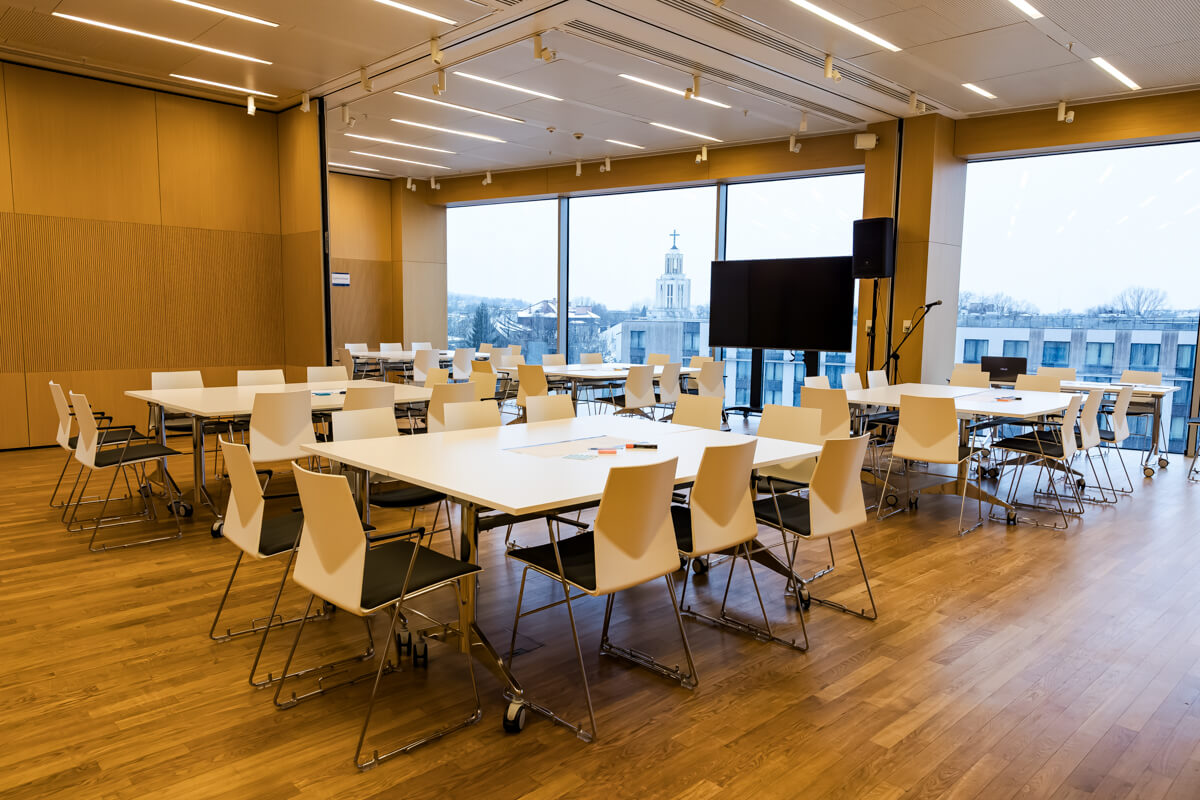
A static, front-facing setup creates a very different dynamic than a modular environment where sessions shift, groups break out, and participants reconfigure the space throughout the day.
This is where your thinking on adaptive formats and designing for the unexpected becomes crucial. If the programme allows for flexibility, the venue needs to support it.
Can furniture be moved easily? Are there adjacent spaces that can host parallel conversations? Is there room for moments that were not planned but might emerge?
Even small details matter here. Ceiling height, natural light, acoustics, and sightlines all influence attention and energy.
And then there is rhythm. How people transition between moments.
If everything happens in the same room, transitions need to be designed differently than in a venue where movement is part of the experience. This connects closely to your work on the in-between moments, the arrival, the pauses, the informal exchanges that often carry as much value as the formal agenda.
The non-negotiables every venue should meet
Only once the goal, audience, and format are clear does it make sense to assess the fundamentals. These are not differentiators, they are baselines.
Accessibility
A venue should be usable by everyone you intend to welcome. This goes beyond step-free access. It includes clear signage, proximity to public transport, intuitive navigation, and an environment that does not create unnecessary barriers.
Sustainability
This is no longer a bonus. It is part of responsible event design. Energy use, waste management, catering choices, and the broader environmental footprint of the venue all play a role. This is where your work on conscious giveaways and material choices can naturally connect.
Technical reliability
Not every event needs complex production, but every event relies on stable connectivity, good sound, and responsive technical support are essential. When they fail, everything else is affected.
Operational clarity
A good venue partner makes things easier. Clear communication, flexibility, and an understanding of event needs often matter more than the space itself.
The venue as a quiet collaborator
When all of these layers align, the venue stops being a constraint and starts acting as a collaborator.
It supports the goal without needing to be explained. It makes the audience feel considered. It allows the format to unfold naturally. And it meets the essential standards without drawing attention to them. And that choice is rarely made by comparing floorplans alone. It is made by understanding what the event is trying to do, and selecting the environment that allows it to happen.
Site visits
By the time you reach a shortlist, the big decisions should already be behind you. What remains is a more focused evaluation of how each venue performs across a few key dimensions.
And then, the final layer.
Visit the venue. Not just through photos or floorplans, but in person. Ideally with someone who understands how events actually unfold in space. Details that seem minor on paper often make a significant difference on site.
And yes, your gut feeling matters.
If something feels off during a visit, it usually is. The right venue tends to make things feel easier, clearer, more aligned. Not just on a checklist, but in the way the space responds to what your event is trying to achieve.
Conclusion
Read more
Discover more of our journals, a treasure trove of valuable insights, practical tips, and industry trends that will take your events to the next level.


.jpg)
.jpg)












.avif)